

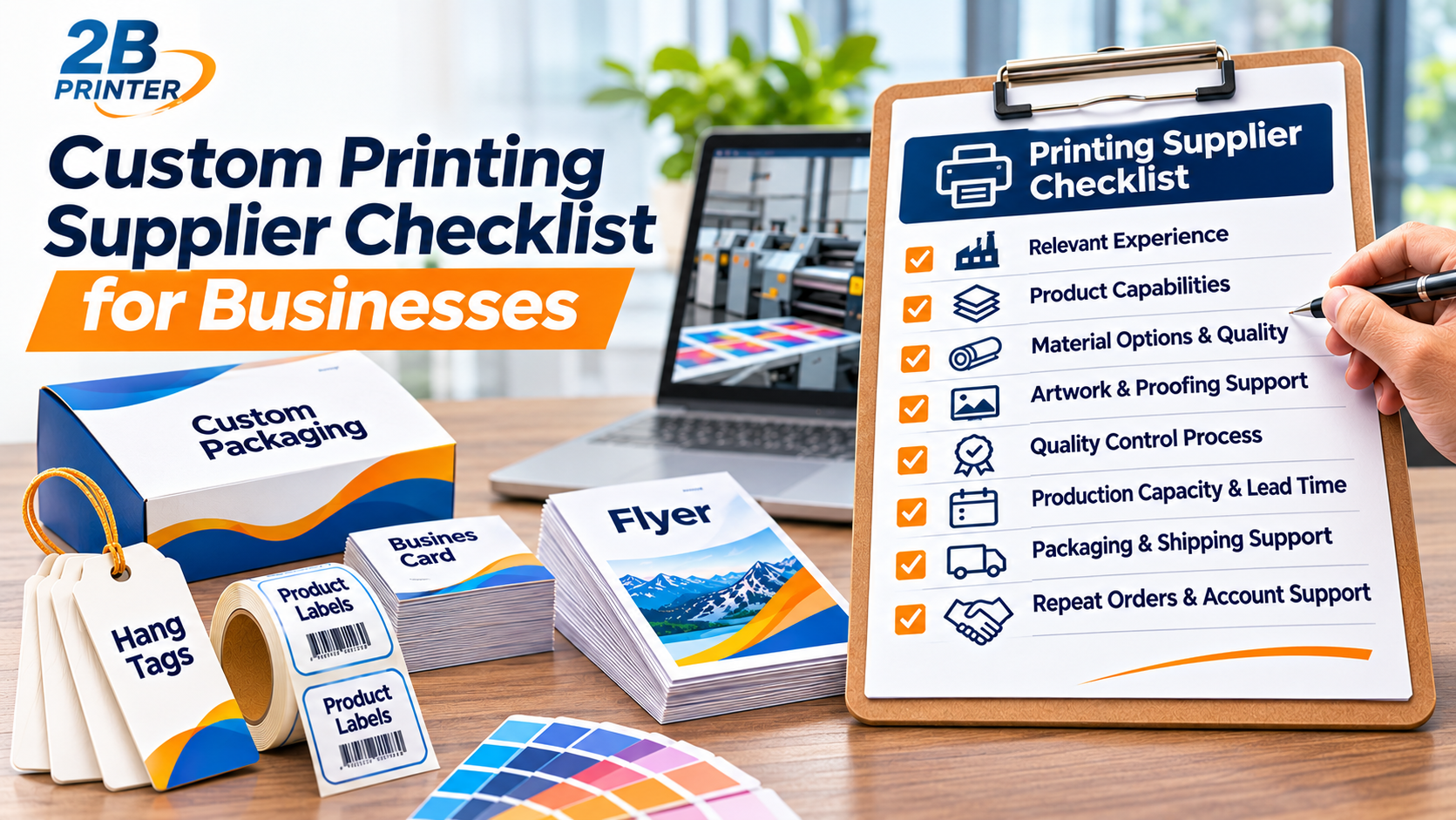
Custom Printing Supplier Checklist for Businesses
Choosing a custom printing supplier is an important purchasing decision for businesses that depend on professionally printed packaging, product labels, hang tags, marketing materials and branded products. The right supplier should be able to understand your product requirements, recommend suitable materials, handle the required customization and maintain clear production and quality procedures. Before committing to a supplier, businesses should evaluate its product capabilities, material knowledge, artwork process, quality controls, communication and ability to support future orders.
A supplier that can print a basic product does not necessarily have the experience or production capabilities required for every custom project. Packaging, specialty labels, retail cards and promotional materials each have different technical requirements.
This checklist helps U.S. business owners, retailers, manufacturers, e-commerce brands and purchasing managers evaluate a custom printing supplier before establishing a business relationship.
1. Define Your Business Printing Requirements Before Selecting a Supplier
Start by identifying the products your business needs and the specifications each product requires. A supplier should be evaluated against the actual needs of your project rather than general claims about printing services.
For example, a retail brand may need custom packaging boxes, hang tags and product cards. An e-commerce company may require branded inserts, shipping labels and promotional materials. A manufacturer may need product identification labels, printed instructions and packaging components.
Prepare a Business Printing Requirements List
- Product category: Identify whether you need boxes, labels, cards, hang tags, brochures, flyers, folders or specialty printed items.
- Quantity: Estimate the volume required for each product and design.
- Dimensions: Define the finished width, height, thickness and construction.
- Material: Identify paper, cardstock, paperboard or other required materials.
- Printing: Specify color requirements and whether printing is needed on one or both sides.
- Finishing: List lamination, foil, embossing, cutting, folding or other requested treatments.
- Usage: Explain where and how the printed product will be used.
- Delivery: Identify your business location, receiving arrangements and required delivery date.
Having these requirements documented will help you determine whether a potential supplier is suitable for your actual project.
2. Check the Supplier’s Experience With Your Product Category
Product experience matters because different printed materials require different production knowledge. Printing a promotional flyer involves different considerations from manufacturing a folding carton, product label or custom header card.
Ask whether the supplier has handled projects similar to the products you intend to purchase. Look for relevant examples, product specifications, samples or documented project references.
Evaluate Experience by Product Type
| Product Category | Experience to Look For | Important Considerations |
|---|---|---|
| Custom Packaging | Printed boxes, folding cartons and packaging components. | Product dimensions, construction, material and finishing. |
| Hang Tags & Cards | Retail tags, header cards and product presentation materials. | Card stock, hole placement, folding and attachment. |
| Labels & Stickers | Product labels, promotional stickers and branding labels. | Application surface, adhesive, material and dimensions. |
| Marketing Materials | Brochures, flyers, postcards and business stationery. | Paper selection, page layout, colors and print finishing. |
| Product Inserts | Backing cards, instruction cards and packaging inserts. | Product fit, printed information and finished dimensions. |
Questions to Ask a Potential Supplier
- Have you produced this type of printed product before?
- Can you provide examples of comparable finished products?
- What specifications should we confirm before production?
- Are there any limitations related to the product’s size or construction?
- Can the same product specifications be used for future orders?
Relevant experience helps you evaluate whether the supplier understands the practical requirements of the project rather than simply accepting a product description.
3. Evaluate Printing and Customization Capabilities
A custom printing supplier should be evaluated according to the production options available for your particular requirements. Customization may involve product dimensions, shape, materials, printing, finishing and structural construction.
Check Product Customization Options
- Custom finished sizes and dimensions.
- Standard and custom product shapes.
- Single-sided and double-sided printing.
- Full-color printing and brand color requirements.
- Different paper and board options.
- Matte, gloss and other finishing options.
- Die cutting, folding and other construction requirements.
- Custom inserts, attachments and packaging components.
Confirm That Options Are Available for Your Specific Project
Do not assume that every printing or finishing option is available for every material and product. A particular coating may be unsuitable for a selected stock, while a custom box may require additional structural preparation.
Ask the supplier to confirm which options can be combined in your specific project and whether any limitations or additional production steps apply.
For packaging projects, review custom printed packaging options and identify whether your product needs boxes, sleeves, inserts, tags or coordinated packaging components.
4. Review the Supplier’s Material Knowledge
Material selection influences how a printed product looks, feels, performs and handles during storage, transportation and use. A supplier should be able to discuss material options based on the intended application.
For example, business cards, product tags, retail boxes and adhesive labels do not necessarily use the same material. Each product requires a suitable substrate and finishing combination.
Check These Material Factors
- Material type: Identify the available paper, cardstock, paperboard or label materials.
- Thickness: Confirm stock thickness or paper weight when relevant.
- Surface: Discuss coated, uncoated, textured or other surface requirements.
- Durability: Explain how the finished product will be stored, handled and used.
- Print appearance: Consider how the selected material affects images, text and brand colors.
- Finishing compatibility: Confirm that the chosen surface supports the requested finishing treatment.
- Application: For labels, describe the surface to which the label will be applied and any relevant exposure conditions.
Ask for Material Recommendations
If your business does not have a fixed material specification, explain the intended product application and desired appearance. A knowledgeable supplier should be able to discuss relevant alternatives and explain their differences.
Avoid choosing materials based on vague descriptions such as premium or heavy-duty without confirming the actual stock and specifications.
See 2B Printers Quality & Materials for information about paper stocks, packaging boards and finishing considerations.
5. Check Artwork Preparation and Design Support
Artwork preparation is an important part of custom printing. Even when a business supplies its own design files, the supplier should explain the technical information needed before production.
Evaluate the Artwork Process
- Which artwork formats are accepted?
- Are there requirements for finished dimensions and bleed?
- How are fonts and linked images handled?
- What image resolution is appropriate for the selected print size?
- How should CMYK and Pantone color requirements be communicated?
- Can the supplier identify technical issues in submitted files?
- How are digital or physical proofs reviewed?
- Can revisions be made before final approval?
Confirm Version Control
Businesses with multiple products or recurring orders should maintain approved artwork versions. Each file should be linked to the relevant product code, size and specification.
This reduces the possibility of producing items with outdated logos, incorrect text, incorrect product information or an old promotional message.
Review the 2B Printers Artwork Guidelines for information about preparing print-ready artwork and confirming production files.
6. Evaluate the Supplier’s Quality Control Procedures
Quality should be evaluated through defined requirements and inspection procedures, not general statements about professional printing. Ask the supplier how it reviews artwork, production output, finishing and completed orders.
Important Quality Control Areas
| Quality Area | What to Confirm |
|---|---|
| Artwork Review | How technical errors and specification differences are identified before production. |
| Color Consistency | How approved brand colors and color expectations are reviewed. |
| Dimensions | How finished sizes, cutting and structural dimensions are checked. |
| Material | How the selected stock is confirmed against the order specification. |
| Finishing | How coatings, lamination, folds, holes and other features are inspected. |
| Packaging | How finished materials are protected and packed for shipment. |
| Final Inspection | How shortages, defects and incorrect products are identified before dispatch. |
Define Acceptance Criteria Before Ordering
If your business has specific quality requirements, document them before approving production. For example, confirm the required dimensions, artwork version, finish, construction and any agreed tolerances.
Ask how defective or incorrectly produced materials are reported and what corrective action may be available under the supplier’s agreed terms.
You can also ask whether inspection records, samples or production references are available for your particular project.
7. Request Samples and Approve Proofs Where Necessary
A sample provides an opportunity to examine material, print appearance, construction and finishing before committing to a larger production order.
Not every project requires a new physical sample. However, sampling may be worthwhile when a product has complex construction, specialty finishing, important color requirements or a high unit value.
What to Evaluate in a Sample
- Correct product size and shape.
- Material type, thickness and surface.
- Print sharpness and text readability.
- Brand colors and artwork placement.
- Cutting, folding and construction accuracy.
- Finishing quality.
- Packaging suitability for transportation and storage.
Ask These Questions Before Approving
- Is the sample representative of the proposed production specification?
- Does sampling involve an additional charge?
- Will a digital proof or physical proof be supplied?
- Who is responsible for reviewing and approving the final artwork?
- Will sample approval be documented?
Keep the approved proof or sample reference with your order records. It can help when reviewing future production batches or resolving differences between the approved design and delivered product.
8. Assess Production Capacity and Order Management
A printing supplier must be able to handle the required quantity, project complexity and production schedule. Businesses should confirm capacity before placing large orders or scheduling materials around an important launch.
Evaluate Production Readiness
- Can the supplier handle your required product quantity?
- Can it manage several product types in one project?
- Can it accommodate different artwork versions?
- Are the required materials available for the project?
- Can it manage the requested finishing processes?
- What is the expected production completion date?
- Are there seasonal or scheduling limitations?
- How are production delays communicated?
Confirm How Orders Are Managed
Ask whether your project will have a dedicated order reference, documented specifications and an identified contact for questions and approvals.
For complex orders, make sure the supplier understands how the individual products relate to one another and whether they need to be produced, packed or delivered together.
Do not assume that production can begin immediately after submitting an enquiry. Confirm the schedule after specifications, artwork and other order conditions have been reviewed.
9. Review Packaging, Shipping and Delivery Support
The finished printed products must reach your business in the required condition and at the correct destination. Packaging and shipping should therefore be evaluated as part of the supplier’s overall service.
Check Delivery Capabilities
- Does the supplier ship to your business location?
- Can it handle your expected carton quantities?
- How are products protected during transportation?
- Can the supplier separate products by SKU or artwork version?
- Can multiple delivery addresses be accommodated?
- Are shipping charges and delivery estimates provided?
- How are tracking details and dispatch updates communicated?
For U.S. Business Buyers
Confirm the complete destination address, city, state and ZIP code when requesting shipping information. For multi-location businesses, supply a separate allocation and delivery instruction for every destination.
Ask the supplier to confirm the available shipping method, expected transit time and any destination-related charges before approving the project.
Review the Packaging Process
The supplier should understand how your products need to be packed. A business ordering hang tags, product cards and packaging inserts may require each item to be bundled separately and identified by its product code.
Clear packaging instructions help prevent receiving errors and reduce additional handling after delivery.
10. Evaluate Communication and Project Support
Clear communication is essential when a custom printing project involves multiple specifications, artwork approvals, production changes or delivery requirements.
A suitable supplier should provide a clear process for handling questions and communicating important project information.
Evaluate the Communication Process
- Is there a clear business contact for quotation and order questions?
- Does the supplier respond with relevant information rather than generic replies?
- Can it explain technical requirements in understandable terms?
- Does it confirm important specifications in writing?
- Can it communicate changes to production schedules?
- Does it explain the next steps after a quotation is submitted?
- Can it handle questions about repeat orders and future specifications?
Check the Process From Enquiry to Production
Understand how the supplier manages the following stages:
- Initial project enquiry.
- Specification and artwork review.
- Quotation and clarification.
- Proof or sample approval where required.
- Production confirmation.
- Shipping and delivery communication.
- Order support after delivery.
A documented process makes it easier to assign responsibilities within your business and avoid misunderstandings.
11. Check Whether the Supplier Can Support Repeat Orders
Businesses that regularly purchase printed materials should consider future orders when selecting a supplier. A supplier may meet the needs of a one-time project but offer limited support for recurring production requirements.
Evaluate Repeat-Order Support
- Can approved artwork and specifications be referenced again?
- Can the supplier identify the product using an internal reference or SKU?
- How are changes to material or finishing handled?
- Can the supplier discuss recurring order quantities?
- Are future production schedules subject to availability?
- How are changes in pricing communicated?
- Can products be packed or allocated for different business locations?
Maintain a Repeat-Order Record
Your business should retain:
- Approved artwork and its revision number.
- Final product specifications.
- Material and finishing references.
- Approved samples or proofs where applicable.
- Previous purchase orders.
- Delivery and receiving records.
- Relevant supplier communications.
This information makes it easier to prepare the next order and identify any specification changes that need attention.
12. Review Business Terms and Documentation
Before establishing a business relationship, review the supplier’s commercial terms and determine which documents will govern the purchase.
Important Documents and Information
- Business identity: Confirm the supplier’s legal business name and appropriate contact details.
- Quotation: Retain the written quotation and its validity period.
- Purchase order: Document the products, quantities, specifications, delivery location and approved price.
- Artwork approval: Retain the final proof and confirmation before production.
- Payment terms: Confirm deposits, payment milestones, balances and accepted methods.
- Cancellation terms: Understand what happens when a project is cancelled or changed.
- Quality terms: Review the process for reporting shortages, defects or incorrect products.
- Shipping documents: Confirm the documents supplied with dispatched orders.
- Confidentiality: Establish how proprietary artwork, product designs and business information are handled.
For regulated or sensitive product applications, ask whether the supplier can provide the specific documentation required for your project. Verify any claims, certifications or compliance documents independently rather than relying on an unsupported statement.
The goal is to make sure that the purchasing requirements, production expectations and commercial responsibilities are documented before the order proceeds.
13. Custom Printing Supplier Evaluation Scorecard
Use a structured scorecard to evaluate potential suppliers against the requirements that matter to your business. This is a supplier qualification tool, not simply a price comparison.
| Evaluation Criteria | Suggested Weight | What to Check |
|---|---|---|
| Relevant Product Experience | 15% | Experience with your specific product category and application. |
| Production Capabilities | 15% | Ability to meet dimensions, customization and finishing requirements. |
| Material Knowledge | 15% | Ability to discuss appropriate stocks, boards and material options. |
| Quality Control | 20% | Artwork review, production checks, samples and defect handling. |
| Production Management | 10% | Ability to manage the required quantities and schedule. |
| Communication | 10% | Clarity, responsiveness and documented project updates. |
| Shipping and Packaging | 10% | Ability to meet delivery and packaging requirements. |
| Repeat-Order Support | 5% | Ability to reference previous specifications and support reorders. |
How to Use the Scorecard
Give each supplier a rating from 1 to 5 for every criterion:
- 1 = Does not meet requirements.
- 2 = Significant limitations.
- 3 = Meets basic requirements.
- 4 = Strong capability.
- 5 = Fully meets or exceeds requirements.
Supplier Score = Sum of (Rating × Weight)
Use decimal weights such as 15% = 0.15. The maximum possible score is 5.
For example, a supplier with a strong quality-control process but limited experience in your product category may score differently from a supplier with extensive product experience and weaker delivery support.
Adjust the weights according to your business priorities. A packaging manufacturer may assign more importance to construction and material capabilities, while a company purchasing recurring promotional materials may prioritize artwork handling and delivery.
Do not allow a high overall score to compensate for a critical failure. If a supplier cannot meet a mandatory material requirement, product specification or delivery condition, resolve that issue before considering the supplier qualified.
14. Warning Signs When Choosing a Custom Printing Supplier
A supplier may appear suitable during the initial enquiry but fail to meet important business requirements during production. Watch for the following warning signs:
- Unclear product capabilities: The supplier cannot explain whether it can produce your requested product or finishing.
- Vague material descriptions: It avoids identifying the proposed material or relevant specifications.
- No clear proofing process: The supplier does not explain how artwork is checked and approved.
- Unexplained production timelines: It gives dates without clarifying the production or shipping stages.
- Unclear quality responsibilities: There is no documented process for reporting defects or incorrect products.
- Inconsistent communication: Different representatives provide conflicting project information.
- Unsupported certification claims: It makes quality or compliance claims without providing relevant evidence.
- Unclear business terms: Payment, cancellation or additional charges are not properly documented.
- No repeat-order process: It cannot explain how specifications and approved artwork will be referenced in future purchases.
Request clarification and supporting documentation where necessary. Do not commit to a major purchase until critical questions have been resolved.
15. Final Custom Printing Supplier Checklist
Use this checklist during supplier evaluation. Mark each item as confirmed, pending or not applicable according to your project’s requirements.
Product and Experience
- Supplier has relevant experience with the required product category.
- Product examples or references have been reviewed.
- Required quantities and product variations can be discussed.
- Custom size and construction requirements have been reviewed.
Materials and Production
- Suitable material options have been identified.
- Material thickness and other important specifications are documented.
- Printing and finishing options are confirmed for the project.
- Production scheduling and capacity have been discussed.
Artwork and Quality
- Artwork requirements and accepted file formats are understood.
- Proofing and approval procedures have been established.
- Quality inspection procedures have been reviewed.
- Samples or proofs have been reviewed where necessary.
- Defect and correction procedures are documented.
Business and Delivery
- Supplier identity and business contact information are verified.
- Commercial terms have been reviewed.
- Packaging and shipping arrangements are confirmed.
- Required delivery dates are understood.
- Repeat-order and customer support procedures are clear.
Once the essential requirements are confirmed, retain the supplier evaluation, approved specifications and relevant purchasing documents for future reference.
How 2B Printers Fits Business Printing and Packaging Requirements
Businesses evaluating a custom printing supplier should look for product options that match their actual purchasing needs. 2B Printers is positioned around B2B custom printing and packaging projects for businesses in Cleveland, Northeast Ohio and across the USA.
Its product range includes custom packaging, hang tags and header cards, labels and stickers, business cards, flyers, postcards, brochures and other commercial printing materials.
Businesses can review the relevant product categories and discuss project specifications based on the intended application, quantity and desired presentation.
Before submitting a project, prepare the product dimensions, quantities, artwork, material preferences and finishing requirements. If some technical details are not finalized, explain the intended use so the team can review the requirements.
Visit the Quality & Materials page to explore material considerations or use the Request a Quote page to discuss your printing project.
Frequently Asked Questions About Choosing a Custom Printing Supplier
1. What should businesses look for in a custom printing supplier?
Businesses should evaluate relevant product experience, printing capabilities, material knowledge, customization options, artwork support, quality control, production capacity, delivery arrangements and repeat-order support. The supplier should be able to address the requirements of the specific project.
2. How do I know whether a printing supplier is suitable for my business?
Compare the supplier’s product experience and production capabilities with your actual requirements. Review relevant samples, confirm material and finishing options, discuss quality procedures and verify that the supplier can manage your required quantities and delivery schedule.
3. Should I ask a printing supplier for samples?
Yes, when material, color, construction or finishing quality is important to the purchasing decision. Request samples representative of the product specifications being considered and clarify whether sampling involves additional costs.
4. Why is material knowledge important when choosing a printing supplier?
Different printed products require different materials. Paper, cardstock, packaging boards and label substrates can affect durability, print appearance, construction and intended application. A supplier should be able to discuss material options in relation to your product requirements.
5. What questions should I ask before placing a custom printing order?
Ask about product capabilities, material availability, minimum quantities where applicable, printing methods, finishing, proof approval, quality checks, production timelines, shipping, payment terms and procedures for handling defective or incorrect products.
6. How can I check the quality of a custom printing supplier?
Review samples, material specifications, artwork approval procedures and quality inspection practices. Ask how finished dimensions, color, cutting, finishing and packaging are checked and how quality issues are handled after delivery.
7. Can one printing supplier handle multiple business products?
Some printing suppliers offer several product categories, such as packaging, labels, hang tags, cards, flyers and brochures. Confirm that the supplier can meet the technical requirements for each product rather than assuming all categories are handled in the same way.
8. Why is repeat-order support important?
Businesses with recurring printing requirements need a consistent reference for approved artwork, materials, dimensions and finishing. A documented repeat-order process can reduce specification confusion and make future purchasing easier to manage.
9. What documents should I keep when working with a printing supplier?
Maintain the quotation, purchase order, product specifications, approved artwork, proofs, material references, delivery documents and relevant communication. These records help your business manage production approvals, receiving inspections and repeat purchases.
10. How can I request a custom printing quote from 2B Printers?
Visit the 2B Printers Request a Quote page. Share your product type, quantity, dimensions, material preference, printing and finishing requirements, artwork and project details for review.
Looking for a Custom Printing Supplier for Your Business?
Explore custom printing and packaging options from 2B Printers. Share your product requirements, quantities, artwork and specifications to discuss a printing solution for your business.
Request a Custom Printing Quote →