

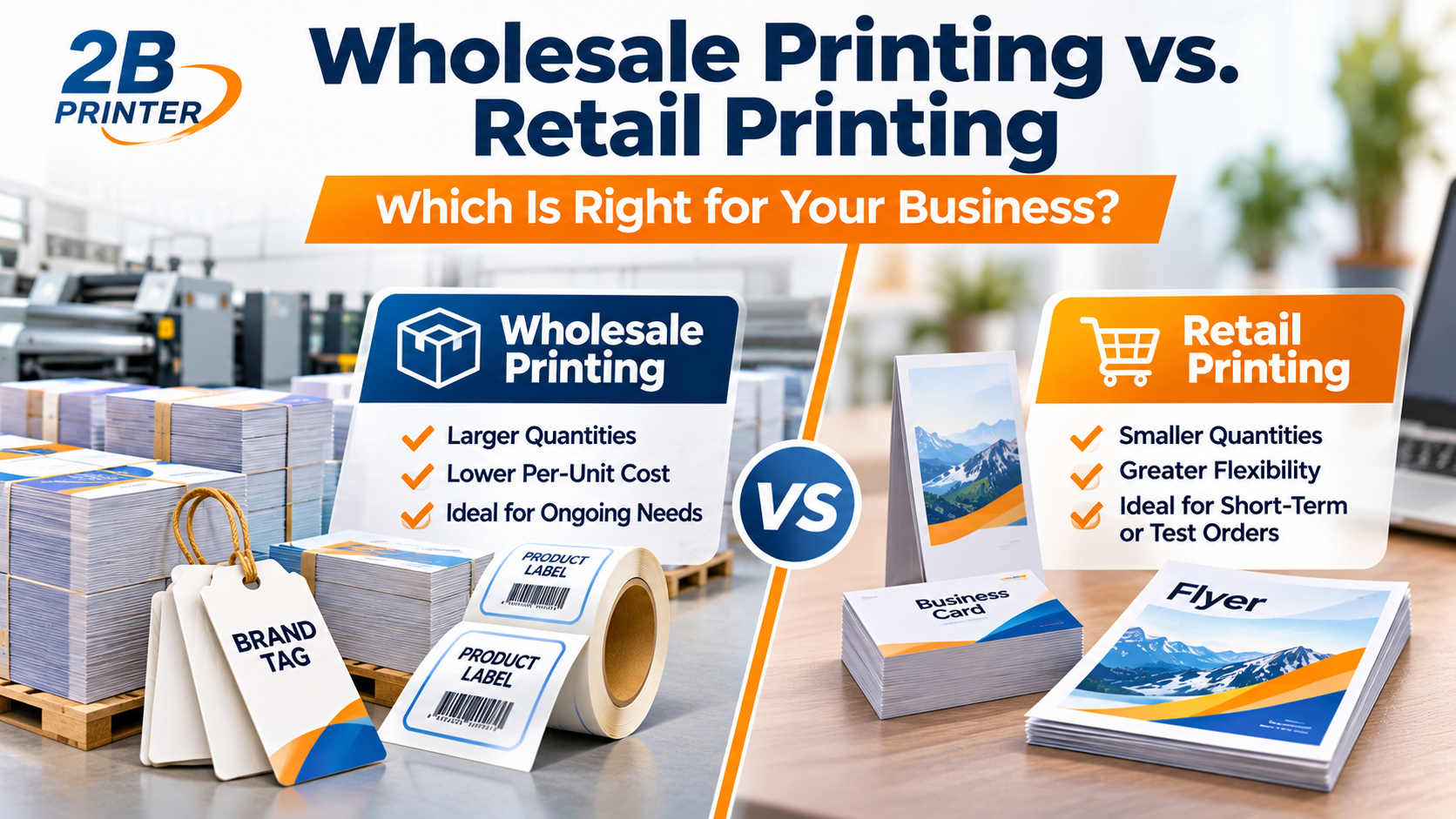
Wholesale Printing vs. Retail Printing: Which Is Right for Your Business?
Choosing between wholesale printing and retail printing affects how your business purchases printed materials, manages inventory and controls production costs. Wholesale printing generally suits businesses that need larger quantities or recurring print supplies, while retail printing is often more practical for smaller orders, occasional projects or businesses testing new designs.
The right option depends on your order volume, product specifications, purchasing frequency, budget and delivery requirements. A business that orders thousands of product labels every month has different printing needs from a startup that needs a small batch of business cards or promotional flyers.
This guide compares wholesale printing and retail printing to help business owners, retailers, manufacturers and e-commerce companies select the purchasing model that fits their operations.
What Is Wholesale Printing?
Wholesale printing is a purchasing model in which businesses order printed products in larger quantities, often directly from a printing supplier or manufacturer. The order may include standardized products, custom printed materials or multiple products manufactured for business use.
Wholesale printing is commonly used by companies that need a consistent supply of printed materials for retail, distribution, product packaging, marketing campaigns or ongoing business operations.
Common Wholesale Printing Products
- Custom product labels and stickers
- Hang tags and header cards
- Product packaging and printed inserts
- Business cards and promotional materials
- Brochures, catalogs and marketing collateral
- Product cards and backing cards
Wholesale printing can be useful when a business requires a repeatable specification, predictable replenishment and a larger quantity of finished materials.
For example, an apparel brand may purchase printed hang tags and product cards for an entire collection, while a manufacturer may order labels for several product lines.
What Is Retail Printing?
Retail printing generally refers to purchasing printed products in smaller quantities through a retail-oriented printing service or order process. It is often suitable for individuals, small businesses and organizations that need limited quantities or occasional print jobs.
Retail printing can be a practical choice for businesses that do not need large inventories or are not ready to commit to a substantial order.
Common Retail Printing Requirements
- A small batch of business cards
- Limited quantities of flyers or postcards
- Short-run event invitations
- Test quantities for new designs
- Small quantities of promotional materials
Retail printing may also provide convenience for businesses that need a quick, straightforward order without extensive purchasing or inventory planning.
Wholesale Printing vs. Retail Printing: Key Differences
The main difference is how the business approaches purchasing, quantity, inventory and ongoing print requirements. Wholesale printing typically supports larger purchasing volumes, while retail printing typically supports smaller or more occasional requirements.
| Comparison | Wholesale Printing | Retail Printing |
|---|---|---|
| Order Quantity | Often larger quantities | Often smaller quantities |
| Typical Buyer | Businesses, retailers, brands, manufacturers and distributors | Individuals, startups and businesses with limited print needs |
| Pricing Structure | May include quantity-based pricing | May use standard pricing for smaller runs |
| Inventory | Requires planning for storage and usage | May require less inventory management |
| Customization | Can support custom specifications and multiple products | Often suited to standard or simpler custom requirements |
| Purchasing Frequency | Often recurring or planned | Often occasional or project-based |
| Best Fit | Businesses with consistent or higher-volume demand | Businesses with low, uncertain or one-time demand |
These are general purchasing patterns rather than strict rules. Some suppliers offer wholesale services for smaller orders, and some retail printing services can handle large quantities.
How Printing Costs Compare
One of the main reasons businesses compare wholesale and retail printing is cost. However, the best purchasing decision requires evaluating the total cost of the order rather than looking only at the unit price.
Wholesale Printing Costs
Larger orders may reduce the unit cost when setup and production expenses are distributed across more finished units. The amount of savings depends on the product, quantity, material, finishing requirements and supplier pricing.
Wholesale purchasing may also introduce additional expenses related to inventory storage, handling, shipping and the risk of unused printed materials.
Retail Printing Costs
Smaller orders may have a higher unit price, but the business can purchase only the quantity it currently needs. This can reduce the amount of money tied up in unused inventory.
Retail printing may therefore be more cost-effective for a business with low demand, frequent design changes or a product that has not yet been tested in the market.
Compare the Total Cost of Ownership
When evaluating different printing options, compare quotations for the same product specifications and delivery requirements. Include the cost of storing and managing inventory if your business plans to order a large quantity.
A lower quoted unit price does not necessarily mean a lower total cost for your business.
Advantages and Limitations of Wholesale Printing
Advantages
- Potential quantity-based pricing savings
- Suitable for recurring business requirements
- Can support multiple products in one purchasing project
- Helps plan inventory for regular consumption
- Can simplify repeat purchasing with approved specifications
Limitations
- May require a larger initial purchase
- Can increase storage requirements
- Unused inventory may become obsolete
- Requires accurate demand forecasting
- Large orders may require more planning and coordination
Advantages and Limitations of Retail Printing
Advantages
- Useful for smaller quantities
- Lower inventory commitment
- Practical for testing new designs
- Can suit one-time projects
- May be easier to order for immediate needs
Limitations
- Higher unit prices may apply
- Repeated small orders may increase total costs
- May be less suitable for large recurring demand
- Product options depend on the supplier
- Frequent reordering may require extra administration
Which Printing Model Fits Your Business?
The best option depends on how your business uses printed materials. Evaluate the following scenarios before deciding.
Choose Wholesale Printing If:
- Your business regularly consumes large quantities of printed materials.
- You have predictable demand across several months.
- Your products use stable artwork and specifications.
- You have adequate storage and inventory management.
- You want to compare quantity-based pricing options.
Choose Retail Printing If:
- You need only a small number of printed items.
- You are testing a new product, design or campaign.
- Your demand is unpredictable.
- Your business frequently changes printed information.
- You want to avoid holding excess inventory.
Business Printing Examples
Example 1: An Apparel Brand
An apparel company needs hang tags and product cards for a collection of clothing. It expects to sell thousands of units and has confirmed the artwork and product specifications.
Wholesale printing may be appropriate because the company has a defined quantity requirement and can use the printed materials throughout the collection’s production cycle.
Explore custom hang tags and header cards for apparel and retail product applications.
Example 2: A Startup Testing a Product
A new business is launching a product and wants a small quantity of labels to test packaging and customer response before committing to a larger order.
A smaller print run may be more suitable because the business has not yet established predictable demand.
Example 3: A Manufacturer With Recurring Requirements
A manufacturer uses printed product labels and identification cards across several production batches. It has established specifications and can estimate monthly consumption.
The manufacturer may benefit from planned wholesale purchasing, provided the order quantity aligns with inventory needs and product changes.
Example 4: A Business Running a One-Time Campaign
A company needs flyers and postcards for a single event or promotional campaign. It has a fixed campaign quantity and no ongoing need for the same printed materials.
A smaller or project-based printing order may be more practical than purchasing excess inventory for future use.
View flyers and postcards for business marketing applications.
How to Choose a Printing Supplier
After deciding which purchasing model suits your business, compare suppliers based on their ability to meet your actual printing requirements.
1. Check Product Capabilities
Confirm that the supplier offers the products, materials, sizes and finishing options required for your project.
2. Review the Quotation
Request pricing based on your specific quantities and specifications. Check what is included and whether setup, packaging and shipping are quoted separately.
3. Confirm Artwork and Proofing
Establish how artwork will be reviewed and approved before production. Keep a copy of the final approved design.
4. Ask About Production and Delivery
Confirm expected production completion, shipping arrangements and delivery requirements before placing the order.
5. Evaluate Repeat-Order Support
If you expect to purchase printed materials regularly, ask how approved specifications and artwork can be used for future orders.
The right supplier should be able to explain the production requirements and provide a quotation that clearly reflects your order.
Can Businesses Use Both Wholesale and Retail Printing?
Yes. A business does not need to use the same purchasing model for every printed product.
For example, a retailer may purchase product labels and hang tags in larger quantities because they are used throughout the year. At the same time, it may order small quantities of flyers or promotional cards for occasional marketing campaigns.
This mixed approach allows businesses to align purchasing decisions with actual demand, inventory requirements and the expected lifespan of each printed design.
Frequently Asked Questions
1. What is the difference between wholesale printing and retail printing?
Wholesale printing generally involves purchasing larger quantities of printed materials for business use, while retail printing generally involves smaller orders for individual or business requirements. Pricing, minimum quantities and available services depend on the supplier.
2. Is wholesale printing cheaper than retail printing?
Wholesale printing may offer a lower unit price for larger orders, but savings depend on the product, quantity, specifications and supplier. Businesses should compare the total order cost, including shipping and inventory expenses.
3. What businesses use wholesale printing?
Retailers, apparel brands, manufacturers, e-commerce companies, distributors and marketing agencies commonly purchase printed materials in larger quantities when they have recurring or predictable demand.
4. Can a small business order wholesale printing?
Yes. Small businesses can use wholesale printing when their quantity requirements justify the purchase. They should compare minimum order requirements, unit pricing, storage needs and total project costs before placing an order.
5. Is retail printing better for startups?
Retail printing may be more suitable for startups that need small quantities, are testing product designs or have uncertain demand. Once sales and usage become predictable, the business can compare larger purchasing options.
6. Can I order different printed products from one supplier?
Many printing suppliers offer multiple product categories. Businesses can ask about ordering products such as business cards, hang tags, product labels, flyers and product cards within the same purchasing project.
7. How do I compare wholesale printing quotations?
Compare quotations using the same product dimensions, material, quantity, printing, finishing, packaging and delivery requirements. Review the complete project cost rather than comparing unit prices alone.
8. How can I request a printing quotation from 2B Printers?
Visit the 2B Printers Request a Quote page and provide your product details, quantity, dimensions, material and printing requirements. Include artwork and delivery information where available.
Looking for a Printing Supplier for Your Business?
2B Printers works with businesses on custom printing and packaging requirements. Share your product specifications, quantities and project details to request a quotation for your printing needs.
Request a Printing Quote →