

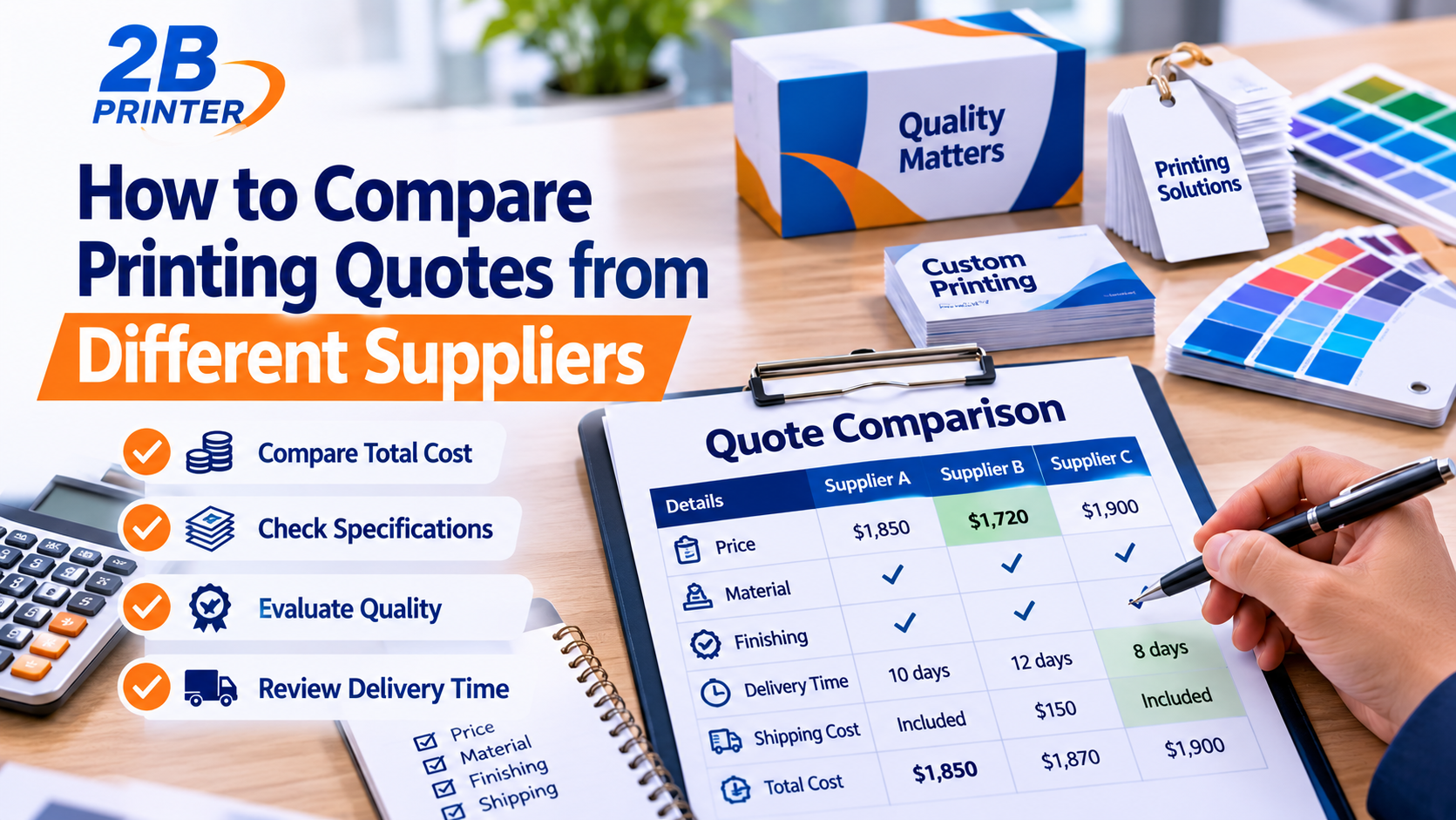
How to Compare Printing Quotes from Different Suppliers
Comparing printing quotes from different suppliers requires more than looking at the total price. Two printing companies may quote different amounts for what appears to be the same product, but differences in material, paper thickness, printing specifications, finishing, packaging, shipping and production terms can change the actual value of each offer. To make a reliable purchasing decision, businesses must compare quotations using the same technical requirements and total project costs.
For retailers, manufacturers, e-commerce brands and procurement teams, choosing the wrong printing supplier can lead to unexpected charges, inconsistent product quality, delayed deliveries and additional production costs. A lower quotation may become more expensive when missing services and additional fees are included.
This guide explains how to evaluate commercial printing quotations, identify pricing differences, calculate the actual cost of an order and assess supplier reliability. It includes a practical comparison table and supplier evaluation scorecard that businesses can use before approving a printing purchase.
1. Before Comparing Printing Quotes, Standardize Your Requirements
A meaningful supplier comparison starts with a consistent project specification. If one printing company quotes a thicker paper stock, another uses a lighter material and a third includes a premium finish, their prices are not directly comparable.
Prepare one standardized specification sheet and send the same requirements to every supplier. This gives each company an equal basis for preparing its quotation.
Your comparison document should establish:
- Product type and intended application.
- Exact quantity and number of artwork variations.
- Finished dimensions and product construction.
- Material type, thickness and paper specifications.
- Printing method, colors and number of printed sides.
- Finishing and customization requirements.
- Packaging and quantity per carton.
- Delivery location and required arrival date.
Your business can use a standardized RFQ document to communicate these requirements. Once quotations arrive, use the same specification sheet to check every line item rather than relying on the supplier’s product description alone.
2. Compare Product Specifications Line by Line
Product specifications are one of the most important parts of a printing quotation. A price difference may reflect a genuine difference in materials or production requirements rather than a supplier offering a better deal.
Check These Technical Details
| Specification | What to Compare | Why It Matters |
|---|---|---|
| Finished Size | Exact width, height, thickness and folded dimensions. | Different sizes can change material consumption and production costs. |
| Material | Paper type, board grade, substrate and thickness. | Material affects durability, appearance and product performance. |
| Printing | Full color, spot colors, one-sided or two-sided printing. | Printing coverage and requirements influence production pricing. |
| Construction | Folds, die cuts, holes, slots, inserts or assembly. | Additional construction processes can affect the final quotation. |
| Finishing | Matte, gloss, lamination, foil, embossing and other effects. | Different finishing options may have separate costs. |
| Packaging | Bundling, protective packaging, carton quantities and labels. | Packaging differences can affect handling and delivery requirements. |
Example: Comparing Custom Hang Tag Quotes
Suppose your apparel company requests quotations for 5,000 custom hang tags. One supplier quotes standard cardstock with a matte finish, while another quotes a thicker stock with additional finishing.
The second supplier may have a higher price because the specifications are different. Before deciding which quotation is better, ask both companies to provide pricing using the same agreed material, thickness, dimensions, print sides, finish and attachment requirements.
For product-specific comparison, review the requirements on the 2B Printers Hang Tags and Header Cards page.
3. Evaluate the Complete Price Breakdown
A printing quotation should explain how the final project price is calculated. Some suppliers provide one combined price, while others separate production, setup, finishing, packaging and shipping charges.
A detailed quotation makes it easier for purchasing teams to identify cost differences and understand what is included in each offer.
Compare These Pricing Components
| Cost Component | What to Verify |
|---|---|
| Production Price | Total cost of manufacturing the specified printed quantity. |
| Unit Price | Cost per printed piece based on the quoted quantity. |
| Setup Charges | Preparation, tooling, plate or other applicable setup expenses. |
| Artwork and Proofing | Artwork modification, physical sample or special proofing charges. |
| Finishing Charges | Lamination, foil, die cutting, folding and additional processes. |
| Packaging | Bundling, carton preparation, protective materials and labeling. |
| Shipping | Freight, shipping method and delivery-related fees. |
| Taxes and Other Fees | Applicable taxes, duties or other charges not included in the price. |
Ask each supplier to confirm whether its quotation includes all required production and delivery services. Where applicable, request separate prices for additional finishing, samples, packaging and optional services.
Also check whether the quoted price applies to the entire order or to each individual design. This is especially important when purchasing several product variations.
5. Compare Material and Print Quality, Not Just Price
Printed products are often part of a company’s brand presentation. A difference in material quality, color consistency, cutting accuracy or finishing can affect how the product looks and performs.
Before selecting a supplier, determine how each company will meet your quality expectations.
Evaluate Material Quality
Check the actual material specifications rather than accepting general descriptions such as premium paper, heavy cardstock or high-quality material. Ask for the paper grade, thickness, material reference or sample where available.
Evaluate Print Quality
Review the following production characteristics:
- Color consistency and reproduction.
- Text and image sharpness.
- Print alignment and registration.
- Cutting accuracy and finished dimensions.
- Surface quality and finishing consistency.
- Fold, crease, attachment and structural accuracy.
- Protection against damage during packaging and delivery.
Request Comparable Samples
If the project justifies sampling, ask suppliers to provide samples that reflect the material, print quality and finishing being quoted.
Comparing different products or unrelated samples will not provide a reliable evaluation. Ask for samples that are representative of the specification in your RFQ.
Also establish how defects will be reported, assessed and resolved if delivered products fail to meet the approved requirements.
6. Evaluate Production and Delivery Times
The cheapest printing quotation is not necessarily the best option when a business has a fixed product launch, retail delivery or campaign deadline.
Compare the actual production and delivery schedule offered by each supplier. Do not assume that the estimated production completion date is the same as the final delivery date.
Compare the Full Project Timeline
| Timeline Stage | Questions to Ask |
|---|---|
| Artwork Review | How long does artwork checking and approval take? |
| Sample or Proof | Is a sample required, and when will it be available? |
| Production Start | When will production begin after approvals and other order conditions? |
| Production Completion | What is the expected date for completing printing and finishing? |
| Packaging | How much time is required for inspection and packing? |
| Shipping | What is the estimated transit time and delivery method? |
Ask suppliers to identify which dates are estimates and which are confirmed commitments. Clarify how delays, changes in specifications and late artwork approvals may affect the schedule.
For businesses with strict deadlines, consider the cost of an alternative supplier if the first supplier cannot meet the required delivery window.
7. Check the Supplier’s Printing Capabilities
A supplier should be evaluated according to its ability to handle your actual product requirements, not simply the number of products displayed on its website.
Different printing projects require different production capabilities. A supplier experienced in commercial marketing materials may not offer every structural packaging or specialty finishing service.
Evaluate Relevant Capabilities
- Product experience: Has the supplier handled products similar to yours?
- Material options: Can it provide the material specifications required for the project?
- Finishing availability: Can it handle the requested cutting, lamination, foil or other finishing?
- Custom production: Can it accommodate non-standard sizes, shapes or construction?
- Order volume: Can it manage your required quantity and product variations?
- Repeat production: Can it support future orders using approved specifications?
Match Capabilities to Your Product Type
For example, custom packaging may require structural design and box construction, while hang tags may require accurate hole placement, card thickness and finishing.
Similarly, flyers and postcards require attention to paper selection, print sides, artwork and finished dimensions.
Review 2B Printers’ product information to understand the relevant project categories:
- Custom Packaging for packaging and printed box projects.
- Hang Tags and Header Cards for retail and apparel tags.
- Flyers and Postcards for business marketing materials.
Confirm the specific production options, material availability and project requirements directly with the supplier before making your final selection.
8. Review Samples and Proofing Procedures
Artwork approval and sample review are important when the appearance of the finished printed product must match your approved design.
Suppliers may have different proofing procedures. Some projects can be reviewed using digital proofs, while others may benefit from physical samples or production-representative examples.
Questions to Ask Every Supplier
- Does the quotation include digital artwork proofing?
- Can a physical sample be produced?
- Does sample production involve additional charges?
- How are color requirements reviewed?
- Will changes after proof approval affect the production schedule?
- What approval is required before full production starts?
When reviewing artwork, check spelling, logo placement, colors, print dimensions, bleed, trim, folds and other product-specific details.
You can refer to the 2B Printers Artwork Guidelines for information about preparing print-ready files, including resolution, CMYK color setup, bleed, fonts and proof review.
9. Compare Payment Terms and Commercial Conditions
Pricing and product quality are not the only factors that determine whether a supplier is suitable. Commercial terms can affect cash flow, purchasing flexibility and the overall risk of a transaction.
Review the following conditions before approving a quotation:
- Payment schedule: Is payment required in advance, in installments or after an agreed milestone?
- Deposit requirements: What deposit is required before production?
- Payment methods: Which payment methods are accepted?
- Quotation validity: How long will the quoted price remain valid?
- Cancellation terms: What happens if the order is cancelled after approval?
- Specification changes: How are changes handled once production has been scheduled?
- Quality disputes: What is the process for reporting defective or incorrect goods?
- Reorder terms: Are prices and production conditions reviewed for future orders?
Request written clarification of any terms that could create additional costs or obligations. Do not assume that all suppliers offer the same payment conditions, replacement policies or production guarantees.
10. Calculate the Total Project Cost Before Choosing a Supplier
To compare printing quotations fairly, calculate the total cost of receiving the finished products at your required destination.
Add any other mandatory project expenses that apply to the quotation. Make sure you do not include optional services that your business does not require.
Illustrative Example: Comparing Two Printing Quotes
A business requests quotations from two suppliers for 5,000 custom printed product cards. Both suppliers are asked to quote the same specifications and delivery destination.
| Cost Component | Supplier A | Supplier B |
|---|---|---|
| Production | $1,700 | $1,550 |
| Setup | $100 | $250 |
| Packaging | $50 | $75 |
| Shipping | $150 | $225 |
| Total Project Cost | $2,000 | $2,100 |
| Quantity | 5,000 pieces | 5,000 pieces |
| Cost Per Unit | $0.40 | $0.42 |
In this illustrative comparison, Supplier B offers a lower production price, but its setup, packaging and shipping charges increase the final cost. Supplier A has a lower total project cost.
This example assumes that both quotations cover equivalent specifications, delivery conditions and acceptable quantities. Real quotations must be checked for any additional taxes, fees or exclusions before comparing them.
Use Cost Per Delivered Unit
Another useful metric is the cost per acceptable unit received by your business.
For example, if a business pays $2,000 and receives 4,950 accepted pieces, the cost per accepted piece is approximately $0.404. This calculation is useful when evaluating orders with shortages or products that fail inspection.
Before using this metric, clarify the supplier’s quantity and quality policies. Do not assume that an estimated production allowance or acceptable defect rate is the same across different suppliers.
11. Use a Supplier Comparison Scorecard
After checking the pricing, specifications and production terms, use a weighted scorecard to compare the suppliers. This is particularly helpful when several quotations are close in price but differ in quality, delivery and service.
Suggested Supplier Evaluation Criteria
| Evaluation Criteria | Suggested Weight | What to Assess |
|---|---|---|
| Specification Match | 25% | Ability to meet all required product and material specifications. |
| Quality and Proofing | 20% | Sample quality, color, finishing and approval process. |
| Total Project Cost | 20% | Complete delivered cost, not just unit price. |
| Production and Delivery | 15% | Ability to meet the required schedule and delivery destination. |
| Communication | 10% | Clarity, responsiveness and handling of project questions. |
| Commercial Terms | 5% | Payment conditions, quote validity and order policies. |
| Repeat-Order Support | 5% | Ability to maintain specifications for future orders. |
These weights are a suggested starting point, not an industry-standard ranking. Adjust them according to your company’s priorities.
How to Score Each Supplier
Give every supplier a score from 1 to 5 for each criterion:
- 1 = Poor
- 2 = Below expectations
- 3 = Acceptable
- 4 = Very good
- 5 = Excellent
Multiply each score by its assigned percentage weight, then add the weighted scores. The highest score indicates the strongest match against your chosen evaluation criteria.
Use decimal weights, such as 25% = 0.25. The maximum possible final score is 5.
A scorecard helps structure the purchasing decision, but it should not override critical requirements. For example, a supplier that cannot meet your required material specification or delivery deadline may be unsuitable regardless of its overall score.
12. Printing Quote Red Flags to Watch For
Before placing an order, review each quotation for incomplete details, unclear conditions and pricing assumptions.
- No detailed specifications: The quote uses general product descriptions without confirming material, size or finishing.
- Unclear total price: Setup, shipping or other mandatory fees are missing.
- Unspecified material: The supplier does not identify the actual material or thickness being quoted.
- Unconfirmed production schedule: Delivery estimates are presented without explaining production and shipping time.
- No clear approval process: Artwork and sample approval requirements are not explained.
- Vague quality terms: No process is provided for addressing defective or incorrect products.
- Unclear payment terms: Deposit, balance payment and quotation validity are not stated.
- Changing quotations: Pricing changes without an explanation of specification or cost changes.
- Unresponsive communication: Important purchasing questions remain unanswered.
Ask for written clarification before approving a quotation. A supplier should be able to explain the price, specifications, production assumptions and commercial conditions associated with its offer.
13. Final Printing Quote Comparison Checklist
Use this checklist before selecting a supplier and issuing a purchase order.
- All suppliers received identical project specifications.
- Product dimensions and construction have been confirmed.
- Material type and thickness have been compared.
- Printing colors and print sides match the requirement.
- Finishing and customization costs are included.
- Setup and additional charges are identified.
- Packaging and carton requirements are confirmed.
- Shipping and delivery costs are included.
- Production and delivery timelines have been reviewed.
- Samples or proofs have been evaluated where necessary.
- Payment and cancellation terms are understood.
- Quality and shortage policies are documented.
- The final project cost is calculated.
- The selected supplier can meet the essential project requirements.
Retain the comparison table, quotations, approved artwork and purchase order for future reference. These documents can also help your business evaluate repeat orders and identify changes in pricing over time.
Frequently Asked Questions About Comparing Printing Quotes
1. How do I compare printing quotes from different suppliers?
Compare quotations using identical product specifications, quantities, materials, printing, finishing, packaging and delivery requirements. Then evaluate the complete project cost, quality, production timeline and payment terms before selecting a supplier.
2. Why are printing quotes different for the same product?
Price differences can result from material grade, thickness, dimensions, printing requirements, finishing, production methods, setup costs, packaging and shipping. Suppliers may also include different services in their quotations, so compare the detailed cost breakdown before making a decision.
3. Should I choose the cheapest printing supplier?
Not automatically. A low quotation may exclude important production or delivery costs, or it may be based on different specifications. Evaluate quality, total project cost, delivery performance and supplier capabilities alongside price.
4. What is included in a commercial printing quotation?
A commercial printing quotation may include production, material, setup, printing, finishing, packaging and shipping charges. The exact inclusions depend on the supplier and project, so request an itemized breakdown and written confirmation of exclusions.
5. How can I identify hidden printing costs?
Ask about setup, tooling, artwork adjustments, samples, special finishing, packaging, freight, taxes and rush production charges. Confirm which services are included in the quoted amount and which will be billed separately.
6. Should I request samples before choosing a printing supplier?
Samples are useful when material, color, finish or product construction significantly affects the purchasing decision. Request samples representative of the specifications being quoted and check whether sampling involves an additional cost.
7. How many printing suppliers should I compare?
There is no fixed number for every project. Comparing multiple qualified suppliers can help establish a meaningful price and capability benchmark. Focus on suppliers that can meet your specifications rather than collecting quotations from companies that cannot provide the required product.
8. What is the difference between unit price and total printing cost?
Unit price represents the cost per printed piece, while total printing cost includes the complete order expenses, such as production, setup, finishing, packaging, shipping and applicable taxes or fees. A lower unit price may still result in a higher total purchase cost.
9. How do I compare suppliers for repeat printing orders?
Evaluate their ability to maintain approved specifications, material consistency, artwork references, pricing clarity, production schedules and communication. Also review how future price changes and repeat-order conditions will be handled.
10. How can I request a printing quotation from 2B Printers?
Visit the 2B Printers Request a Quote page. Provide your product, quantity, dimensions, material, printing and finishing requirements along with available artwork and project details. The team can review the information and prepare project-specific pricing.
Looking for a Printing Quote for Your Business?
2B Printers provides custom printing and packaging solutions for businesses. Share your product specifications, quantities, artwork and project requirements to discuss a suitable printing solution and request a project-specific quotation.
Request a Printing Quote →